
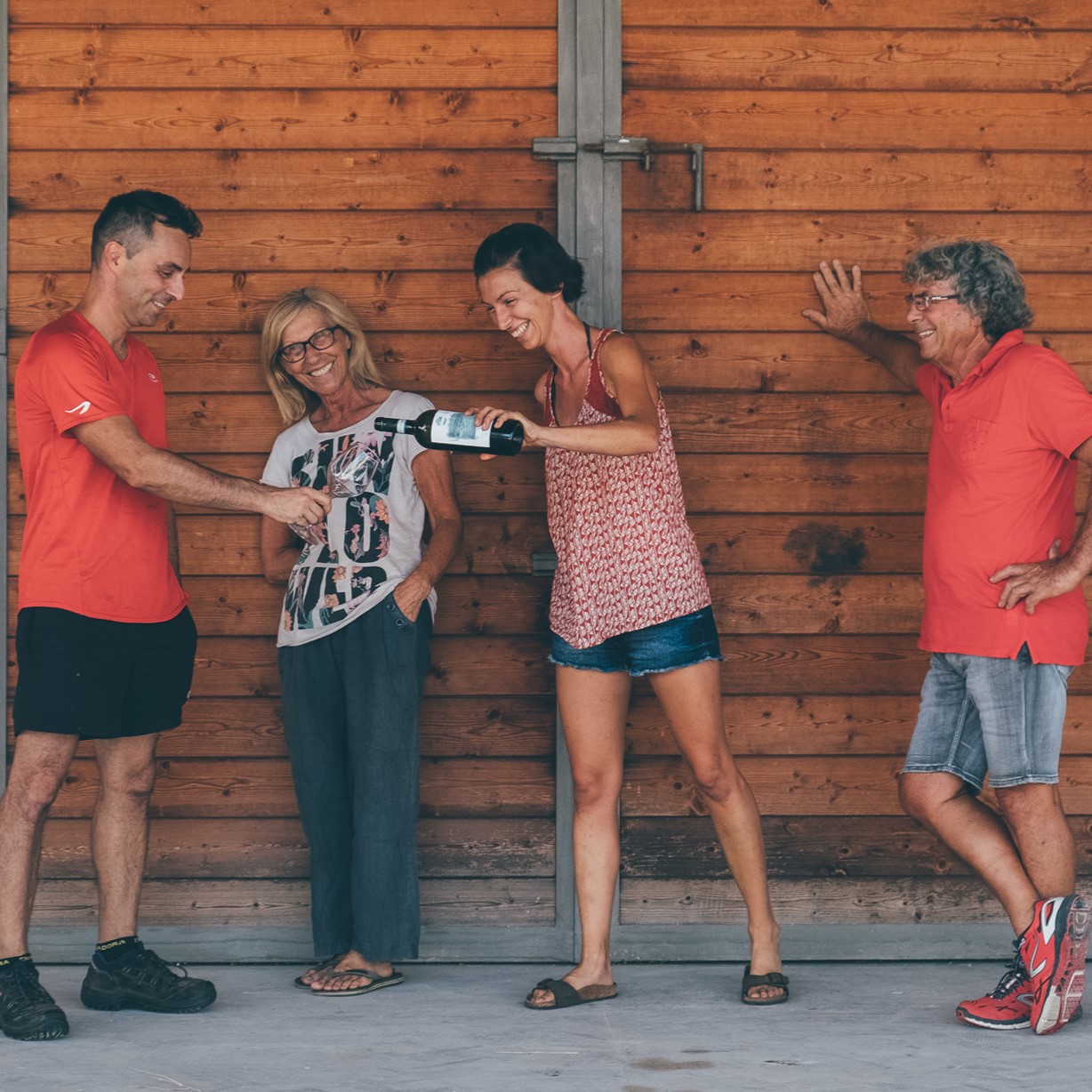
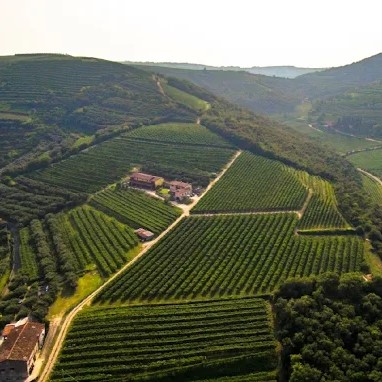
This month, we’re thrilled to bring our Wine Talks series back to our blog. Last week, on a scorching morning in mid-June, we visited Giorgio and Emanuela Marcolini at their winery Il Monte Caro in Mezzane di Sotto, in eastern Valpolicella. The Monte Caro project began in 1986, when Enzo, Giorgio and Emanuela’s father, fell in love with this rugged landscape and, with great effort and dedication, began cultivating it. Emanuela and Giorgio took over the winery in 2014, establishing the winery and dedicating the project to the well-being of their hill. For this reason, they chose to practice organic farming, paying increasing attention to soil vitality and biodiversity, planting fruit trees, studying the wild herbs that grow in the vineyards, and maintaining several beehives.
Our meeting with Giorgio and Emanuela gave us the opportunity to discuss their experience of the region and their understanding of wine, and we’ll share it below.
As a starting point for our talk, I propose the word VISION, because when your dad arrived here and decided to buy this land, there was nothing here. So we can say he was able to imagine what this place could potentially become.
Giorgio: He did indeed had a great vision, because I also remember that when we came to see the land, when we were still deciding whether to buy it or not, thinking of something like that was really difficult; it took a lot of imagination. So the vision was there, and it was this that won out in the management of this place and in the first part of this adventure, because it wasn’t just a “poetic” vision, but a very practical one. In fact, step by step, prioritizing the most important things, we began to build everything you see today. I remember that, beyond the structures, the mountain wasn’t designed as it is today; it was practically unworkable, and there was no water. So little by little, we laid the foundations for coming to live here, and then for creating what I’d like to call a “second vision,” the winery. What guided our family’s choices was the great willpower and energy of our father, especially, but we were all involved, including our mother, who in some way shouldered the consequences of the choices of this man, who was a photographer and who came to build here in his spare time. We ourselves were studying at the time, but during vacations or when there was no study to be done, we helped with the fruit harvest. From there, we began to imagine, in addition to growing fruit and vegetables (we produced a wider variety back then), starting another business, the winery. And at this point, the vision isn’t so much about making wine, but about doing it by returning to our grandparents’ concept of doing it well. We claim to sell wine because it’s good, with the understanding that we make it the way it used to be, only with grapes, which isn’t at all a given today. So here the vision is organic, which isn’t just a way of farming, but a way of life.
Connected to this, another aspect I wanted to touch on is the relationship with the LAND, especially given that each of your wines is the fruit of a specific plot. I really like the concept that your wine isn’t worked much in the cellar, but is first and foremost born in the vineyard.
Emanuela: In the beginning, we wanted to use all the grapes from the hill in all our wines, because we believed the hill was a unique cru, a special place that we wanted to express in every wine. My father tried to tell us that the characteristics of the grapes could vary greatly from one vineyard to another, but initially we didn’t listen to him very much. So, bringing the wine ever closer to the land was a journey, it’s not always been that way. The idea of making wine outside of the cellar instead has always been there, but tying the wine to a specific vineyard is something that came slowly, seeing in practice the differences my father told us about, then studying the soils and also experiencing the place. Until 2014, I lived elsewhere; Giorgio was here but had another job, so we didn’t experience the place firsthand. However, by coming to live here, things became clearer for us too. We began experimenting with separate vinifications of grapes from different parts of the mountain, and indeed, especially in wines made with fresh grapes, you can truly appreciate the difference compared to the wines we made with grapes harvested indiscriminately.
When your dad bought this place, this part of Valpolicella wasn’t yet part of the Valpolicella DOC…
Giorgio: Exactly. In fact, until the 1990s, everything here was cultivated with apricots, plums, cherries, white and red grapes, and olive trees, and that was pretty much the case for everyone. However, those were also different times in terms of markets and climate; the plants were less susceptible to disease, and all the treatments required today weren’t necessary. The market back then was much simpler, and our dad, who was also an entrepreneur and had noticed that things were getting more complicated, had already started replacing plum and apricot trees with vines before the DOC became available. It makes me smile a little, but when I developed a passion for wine, which for me was immediately natural, organic, and biodynamic, seeing these expanses of vineyards was always a bit of a shock, because it would be nice to still have plots of trees among the vineyards that may not produce fruit, but that play a role in biodiversity. We’re actually fortunate, because we have the woods around us, but I’d like to recreate that situation where, not so much for business as for personal subsistence. I’d like to have my own row of cherry trees, a field of oranges and lemons, a vegetable garden… I’d really like to get there, and we’re on the right track, already having an olive grove and woods in addition to the vineyards. In recent years, the dynamics of grape management have also changed significantly, with some people investing in vineyards and others uprooting them. I truly hope the vineyards remain, but only those that deserve it, not those that take up space that should be dedicated to other crops.
I’d now like to move from the agricultural and winemaking aspects of wine to wine as a social element, and to the CONVIVIALITY that still characterizes your understanding of wine.
Emanuela: Getting back to the topic of the current crisis, the most regrettable thing is the loss of wine’s cultural value. We always talk about wine as a beverage that also contains potentially harmful ingredients, but we forget the cultural and social aspect of it: for us in Italy, we don’t open a bottle of wine simply to drink, but because there’s a meeting with someone, a dinner, in short, a social situation that requires an open bottle on the table. And this is precisely a question of culture and tradition. We don’t like to devalue wine without taking this aspect into account, so as a wine style, we’ve chosen to emphasize sociality: a bottle is something you open, savor, take a first sip, and then it stays on the table to accompany you throughout the evening without necessarily being the protagonist. The protagonist is what happens around that bottle, and that’s what’s truly magical for us. A bottle on the table naturally calls for a pairing with food, which should always be there.
Giorgio: Yes, this has always been our perspective. Twelve years ago, we started making wine in an area where everyone else was producing what I call “vanilla-black-eighteen” wines, where the focus is on alcoholic strength, very dark color, tannic structure, and therefore extensive use of wood, drying, and blending. This certainly led to the creation of interesting wines, but it wasn’t really our style, because if you struggle to drink these wines, you lose everything my sister just mentioned. So we started making wines that bucked the trend, and I remember the farmers in the village tasting them and saying, “It’s a Valpolicella like my grandfather used to make,” and I replied, “Yes, but done well!” At the time, no one else was making wine like that anymore, at least here in the area. Then we were lucky enough to be in line with the trend that later emerged for natural, fresh, and light wines, which helped us at the beginning, especially in believing in our ideas. We’re currently experimenting with ways to increase the structure and reduce acidity in our wines, while other wineries that have previously produced very powerful wines are doing the opposite, to improve their drinkability. In short, we’re proud and flattered to have embarked on a path that many others are now pursuing. And this is closely tied to the social and cultural aspect of wine, because by studying the soils, you wonder what was once there, and so you also begin to study your mountain, your town, your valley, precisely on a historical level. This way, you bring home great conversations with the people who come to visit you and want to know more about your business. So, people come here for the wine, but you take them on a tour of the vineyard, you tell them about the town, the church, the bell tower, and then to accompany it all, there’s also the wine.
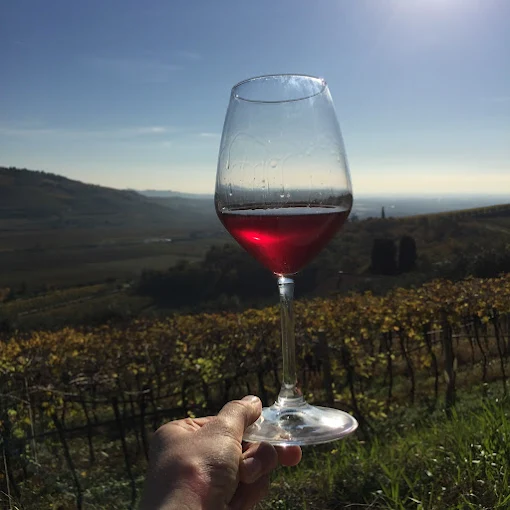
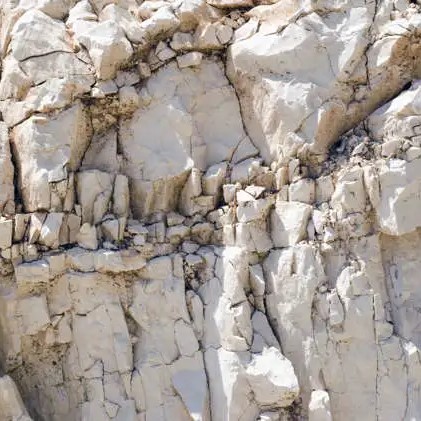
Emanuela: Exactly: “There’s also the wine.” In my opinion, this is the key: obviously you come for the wine, and you can certainly enjoy it, but that’s not all there is to it. I couldn’t say whether our ideas were born thanks to the special place we live in; it’s probably a combination of coincidences. The idea of making wine this way also reflects the way we can do it, because the mountain we’re on naturally fosters freshness and minerality, and nothing else. By valorizing what comes to us from our mountain, we can work within our idea of wine. It’s all interconnected, because even with the same idea of wine, if we were somewhere else, we’d have to act differently, for example, not by valorizing the work in the vineyard but by working more in the cellar. If the land gives you certain things, either you enhance them or you have to work to change them.
Giorgio: Then it must be said that it’s not as if we don’t do anything in the cellar. We’ve studied fermentation extensively, and for us, that’s mostly what cellar work is about. Now we’re studying aging, visiting colleagues and trying to do what we think is most interesting with our wines. Studying fermentation has been really interesting; there’s a lot of chemistry involved, so once you understand the mechanism, you can move on. But working naturally, every year is different; we don’t use any oenological products, so there’s no hard and fast rule. As for aging, however, we realize we still need to work on it; the problem is that we have to wait. In any case, at the end of the work, whether we’ve achieved the result we expected or the aging process has taken a turn you didn’t want, the satisfaction is great, and the wine is drunk anyway. As they say: wines should be drunk in good company, with satisfaction.
Emanuela: Getting back to the social aspect, when we taste wine with customers, if they ask for information, we certainly provide it, but we always try to speak simply, never technically. I think hearing wine talked about as if it were a highly technical matter, understandable only by those who have studied it, tires people out. Ultimately, to appreciate wine, you don’t need to understand every detail of its production; it’s more important for us to understand whether the person tasting our wine is enjoying it and appreciating it in combination with what they’re eating. These are the most everyday aspects of wine.
Of course, it’s the idea of making a wine that isn’t intellectual, but understandable to everyone, because ultimately, wine drinkers are mostly ordinary people, who don’t have a deep knowledge of winemaking.
Emanuela: And that doesn’t mean simplifying it—it doesn’t become a simple wine—but everything around it needs to be made more sociable and accessible to everyone.
Giorgio: It shouldn’t become banal. An example is our Valpolicella, which is a fresh, drinkable wine that always finds its place—before, after, or during meals. The fact that you can appreciate its structure, body, and aroma means there’s a lot of hard work, study, and research behind it, which is essential. Otherwise, we focus on quantity, but wine must be drunk properly, and to do this, it must be satisfying, so it must be simple, convivial, and representative of its identity.
So, you’ll have understood that for us, wine is very important, but more than anything, it’s something that accompanies our lives; it’s not something we die for. It must begin, accompany, and conclude a beautiful adventure filled with so many other things. For us, wine is never the only one that speaks while everyone else is silent; wine must remain silent and accompany, and then it has done its job well, and that means we’ve done it well, too.
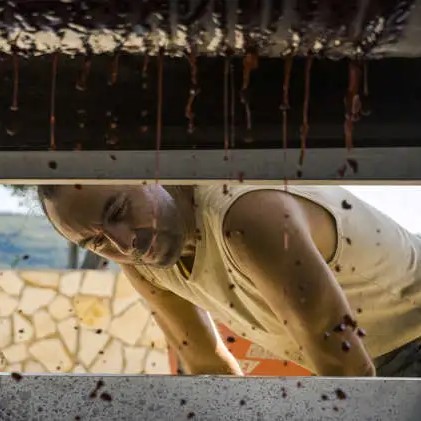
If we’ve piqued your interest and you’d like to meet Emanuela and Giorgio, admire the stunning landscape of Il Monte Caro, and taste their wines, join one of our Soave and Amarone group tours, or email us at [email protected] to check availability on private tours. We look forward to seeing you soon!