
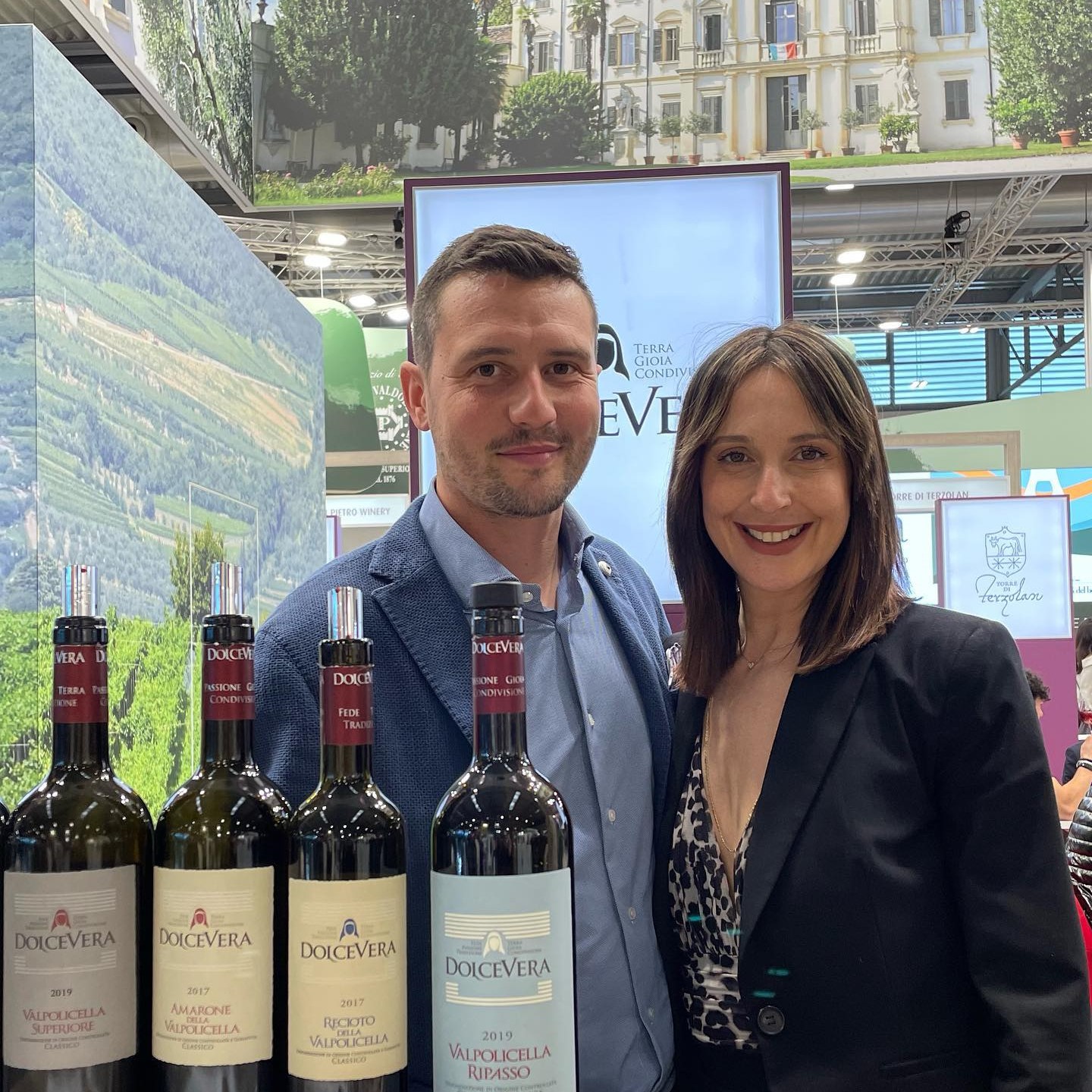
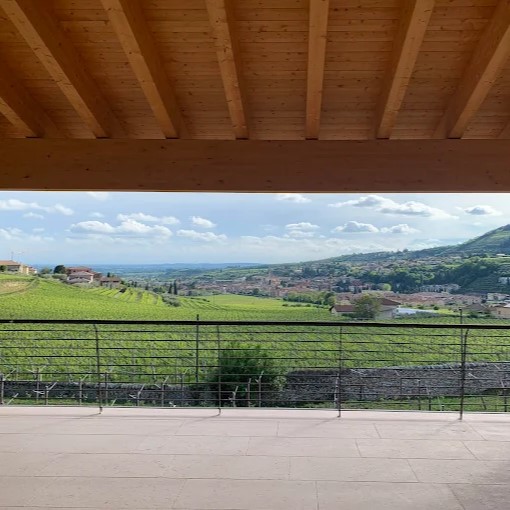
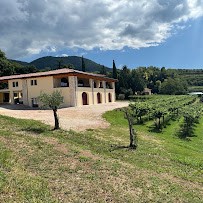
This month, we’ll take you on a deeper exploration of the DolceVera winery, located in Villa, Negrar di Valpolicella. It’s a young winery, founded in 2013 by Marco Benedetti, who, working the vineyards inherited from his grandfather, began harvesting high-quality grapes and transforming them into wine. In recent years, the winery has undergone a major renovation and expansion, and reopened a few months ago with new spaces dedicated to both production and hospitality, as well as a magnificent terrace overlooking the vineyards of the Negrar valley, in the heart of Valpolicella Classica. We met with Marco, along with his partner Clarissa, to discuss what DolceVera means to him, and, as always, you can find our conversation below.
The first point I’d like to share is “TERROIR“. You have all your vineyards in the same location, even if not in a single block, which is now an atypical situation for Valpolicella. So we can state that your wines are ultimately products that represent not only Valpolicella, but this specific place, Villa.
- Exactly. When I began my adventure in the world of wine in 2013, I immediately wanted to highlight this aspect on the website, where on the homepage you can read “DolceVera, expression of a terroir.” We have to use a French word, there is no equivalent in Italian, because it encompasses the unified concept of climate, grape variety, and soil, thus the profound connection between the various elements of a specific place. We have all our plots in Villa, which is a hilly area, like others in Valpolicella, particularly suited to viticulture since ancient times. While vineyards began to be planted later in the high hilly or plain areas, viticulture was already present here in Roman times, as evidenced by the Roman villa discovered a few meters away. A terroir’s vocation is therefore also evident from its historicity, in my opinion. As I always tell visitors, we have very clayey soil here, characteristic of this side of the hill. Moving to other slopes also changes the soil composition, perhaps more calcareous. Incidentally, all the plots are at more or less the same altitude, between 250 and 300 meters above sea level, so even though they’re all divided among themselves, these nearly six hectares of land have similar characteristics and give the wines a clear identity. Same soil, same altitude, south-southwest exposure: the result is a very consistent product. We always have beautiful acidity, thanks to the hillside, combined with good structure and a fairly intense anthocyanin content. The clay soil, in fact, gives the wines a slightly more intense color, which Corvina wouldn’t have on its own.
In Valpolicella, it’s quite common for wineries to have vineyards in different locations, and this can represent both added value and the risk of flattening production.
- Exactly, in some cases these grapes are vinified separately, and then you can really enhance that product, but I think it’s important for small wineries like ours to be able to best interpret the terroir where they are rooted, giving the wine a very specific identity. This is ultimately the challenge in Valpolicella today: you have to stand out. There are many of us, the quality level is high or average for everyone, and as a result, it’s difficult to stand out, much more difficult than sixty years ago, when just working well was enough to stand out from the others. So in a young company like ours, we try to work this way.
Earlier, you mentioned one of the other concepts I’d like to discuss with you: VOCATION. Not only about the Valpolicella region, and Villa in particular, but also in your personal experience. You had begun a different journey, but you soon realized the land was calling you, and you then embarked on the DolceVera adventure at a very young age.
- Yes, I truly believe it’s a predetermined destiny, and ultimately, it’s inevitable that you return to your path. I started out as a clerk in an administrative office, and it was a job I didn’t like; it was clear I wasn’t suited to it. Meanwhile, a passion for the land was growing within me. I was actually born and raised here, so I have very deep roots in this area, like an eighty-year-old vine. My father always took me to the vineyard; he did it as a hobby, to relax on weekends, he had another job, and in the winter he took me pruning. I was a kid and didn’t have a clear idea at the time, but around the age of 20 or 22, I began to develop a curiosity and a desire to learn more about the land where I was born. So I began to become more aware of the place I lived in, of the hectares of vineyards we had; in short, a passion for this work was growing within me, and so I went to work for other wine companies for a while, to learn as much as possible. We’d always had part of the vineyards, while we inherited another from my mother’s uncle, so I found myself with five hectares of vineyards. At that point, it seemed as if all the planets had aligned to show me the path to follow. My grandfather bought this place in 1969 and made wine with his brothers in a house nearby. Previously, they were sharecroppers, meaning they didn’t own the land but merely worked it, so when they had the opportunity, they purchased a plot to start making wine. My grandfather passed away in 1984, still young, and my father had already started working. Since winemaking wasn’t as lucrative at the time as it is now, he kept his other job to support the family, dedicating himself to the vineyards in his spare time. Growing up, I saw in my father the regret of not being able to take over his grandfather’s project, and it sparked in me the desire to try. So in 2013, my father and I decided to take the step of reviving my grandfather’s dream, thirty years after his death.
So it was a revival of your grandfather’s dream, but incorporated into a completely new project.
- Yes, in fact, I always say I’m the first generation, because ultimately I opened the company, but I like to emphasize that as a family, we are deeply rooted here; we don’t come from another world, and we decided to invest in Valpolicella, as sometimes happens. We’ve always farmed these lands; my father did it on Saturdays and Sundays, to relax in the open air and keep his father’s legacy alive. We’re now the fourth generation to live here at Villa, rooted here for a long time.
Then, in recent years, this dream has grown even bigger with this project to expand the winery. Before, you only had the cellar for aging, right?
- Yes, we had a small structure, built by my grandfather in the garage at home, where he placed the tanks for the production part, and another small part of the cellar in the tool shed. We began by renovating this small building we had, transforming it into an aging area and tasting room, but we also needed an operational space for all stages of winemaking, and we were too cramped there. So in 2019, we developed a project for a new facility, and we designed it with hospitality in mind. Aware of our prime location, with a magnificent view of the Negrar valley, we designed the cellar with that in mind. Unfortunately, the work dragged on due to Covid-19 and rising material prices, but we finally managed to complete the work and open it to the public.
Speaking of which, I’d also like to talk about the winery’s name: DolceVera. I know it has a special meaning for you, but beyond that, I really like it because it conveys a sense of kindness and welcome, which I believe represents you very well.
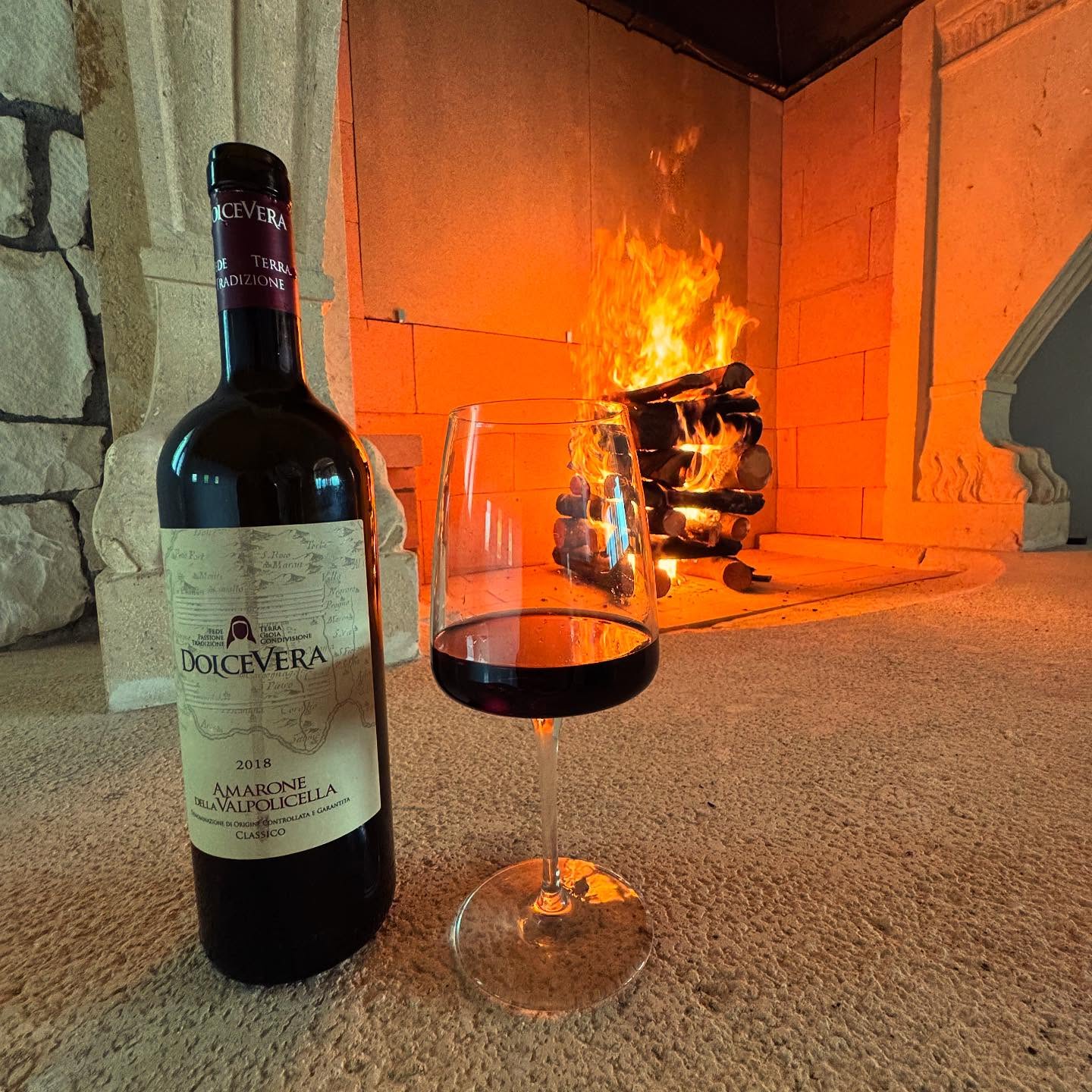
- It’s a somewhat unusual name that piqued curiosity from the beginning, and that’s very pleasing. We went a bit outside the norm with this choice. When we started out, we couldn’t use our last name, Benedetti, because it’s very common here. In the end, we decided to dedicate the winery to a person dear to my father, and later to me and the whole family, with whom a very strong bond was born. This person’s name is Vera and she is a nun (a figure also referenced in our logo). We’ve always wanted to make a “sweet” dedication to this person, and so we wanted to honor her in the winery’s name. We immediately loved the combination of these two words, and she herself advised us on our choice, because the result suggests a deep connection between us and Vera, and indirectly the connection between me and my father. It’s also a tribute to my grandfather, whom I never knew. When we started, it was something completely new, something my father and I decided to launch, and this name represented all of that for us.
It also sounds really beautiful, even without knowing the full emotional significance it has for you.
- Of course, someone has already asked me about the marketing agency that came up with the name, but in reality, it was all very spontaneous. But it’s nice because it means the name is popular and memorable. For foreigners, it works particularly well, because DolceVera sounds a bit like “dolce vita,” and therefore the Italian lifestyle they seek when they come on vacation here. Well, it wasn’t the idea of finding a name that people liked; it was a sincere dedication, not a deliberate one, and only later we realized that it actually worked really well. We were fortunate, because in practice, it’s very important for a name to be effective. If it had been a difficult name to pronounce, perhaps even in dialect, no matter how meaningful it was, it probably wouldn’t have been as well-received. As I said before, we took a risk by going against the grain of traditional company names. We wanted to do something completely different. Being “new,” we wanted to bring a breath of fresh air to the name as well.
In closing, if there’s anything you’d like to add, please do it.
- We can talk for a moment about Clarissa, my partner. Because it’s no longer just me and my father who run the company; for some time now, we’ve also added a feminine touch, which is very important to us. Besides supporting me in life, I really care about her involvement in the company, because she’s a valuable resource. She started out as an administrative assistant, which is her area of expertise, having worked for years in an accounting firm. She’s already relieved me of a lot of work, with insights that are proving very fruitful. When you arrived, we were in the vineyard together, because for family businesses like ours, it’s important to learn how to do all the necessary tasks, even if each person’s primary role is specific. This way, depending on the season, we can help each other with different tasks. So this is a bit of a new development this year, now that our children are growing up, and we’re happy to be able to bring a feminine touch to the winery.
If you’re curious to learn more about DolceVera and taste their wines, join one of our group tours of Valpolicella Classica, or contact us at [email protected] to arrange a private tour. You can also find their wines in our online wine shop; stop by and check them out!